
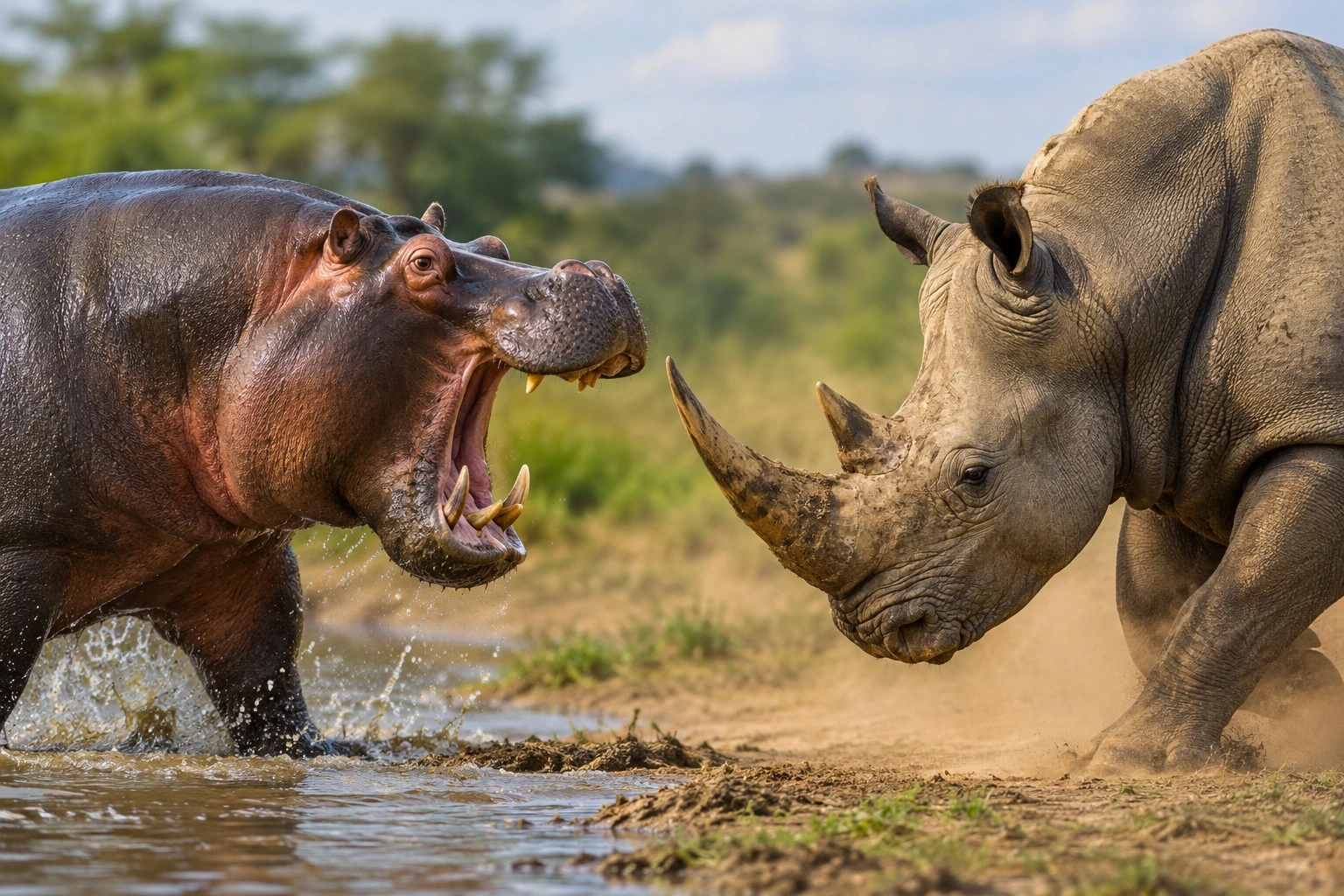
Hey there! Imagine standing on the dusty African savanna and watching two absolute living tanks walk toward each other. In one corner, you have the thick-skinned, gigantic White Rhino charging like a heavy armored vehicle. In the other corner, you have the hyper-aggressive, giant-jawed Hippopotamus guarding its muddy river territory.
Ever looked at these two massive herbivores and wondered: “If a Hippo and a Rhino actually got into a full-blown battle in the wild, who would come out on top?”
It’s one of the most debated matchup questions in the wildlife world! Let’s break down their armor, weapons, aggressive nature, and raw power to find out who really rules the wilderness.
Animal group: Mammals (Artiodactyla vs. Perissodactyla)
Families: Hippopotamidae (Hippo) vs. Rhinocerotidae (Rhino)
Heaviest contestant: White Rhinoceros (up to 5,000 lbs / 2,300 kg)
Deadliest weapon: Rhino’s keratin horn vs. Hippo’s 20-inch tusk teeth
Bite Force: Hippo (~1,260 PSI) vs. Rhino (Weak bite, relies on horns)
Aggression Level: Hippos are far more territorial and aggressive
Global Distribution: Sub-Saharan Africa
Where in the World Are Hippos and Rhinos Found?
Before they clash, where do these two giants live? Both of these incredible species are naturally native to Sub-Saharan Africa.
Hippos spend most of their days submerged in rivers, lakes, and swampy wetlands across countries like Zambia, Tanzania, and Uganda to keep their skin cool under the scorching sun. Rhinos, on the other hand, roam the grasslands, savannas, and shrublands of southern and eastern Africa (in countries like South Africa, Namibia, and Kenya). Because their territories overlap near riverbanks and watering holes during dry seasons, real-life standoffs actually happen!
Size and Weapons: Breaking Down the Competitors
Let’s inspect their battlefield gear:
1. The White Rhino (The Armored Tank)
Weight: 3,500 to 5,000 lbs (1,600 to 2,300 kg)
Primary Weapon: A massive front horn made of solid keratin (the same material as human fingernails) that can grow over 3 feet long!
Armor: Thick, armor-like skin up to 2 inches (5 cm) deep.
Speed: Surprising burst speed of up to 30 mph (48 km/h).
2. The Hippopotamus (The Aggressive Jaw-Crusher)
Weight: 3,000 to 4,000 lbs (1,300 to 1,800 kg)
Primary Weapon: Lower canine tusks that grow up to 20 inches long, backed by a massive 180-degree jaw opening!
Bite Force: An incredible 1,260 PSI—enough to snap a wooden boat or a small crocodile in half.
Temperament: Extremely short-tempered, territorial, and unpredictable.
CritterScore
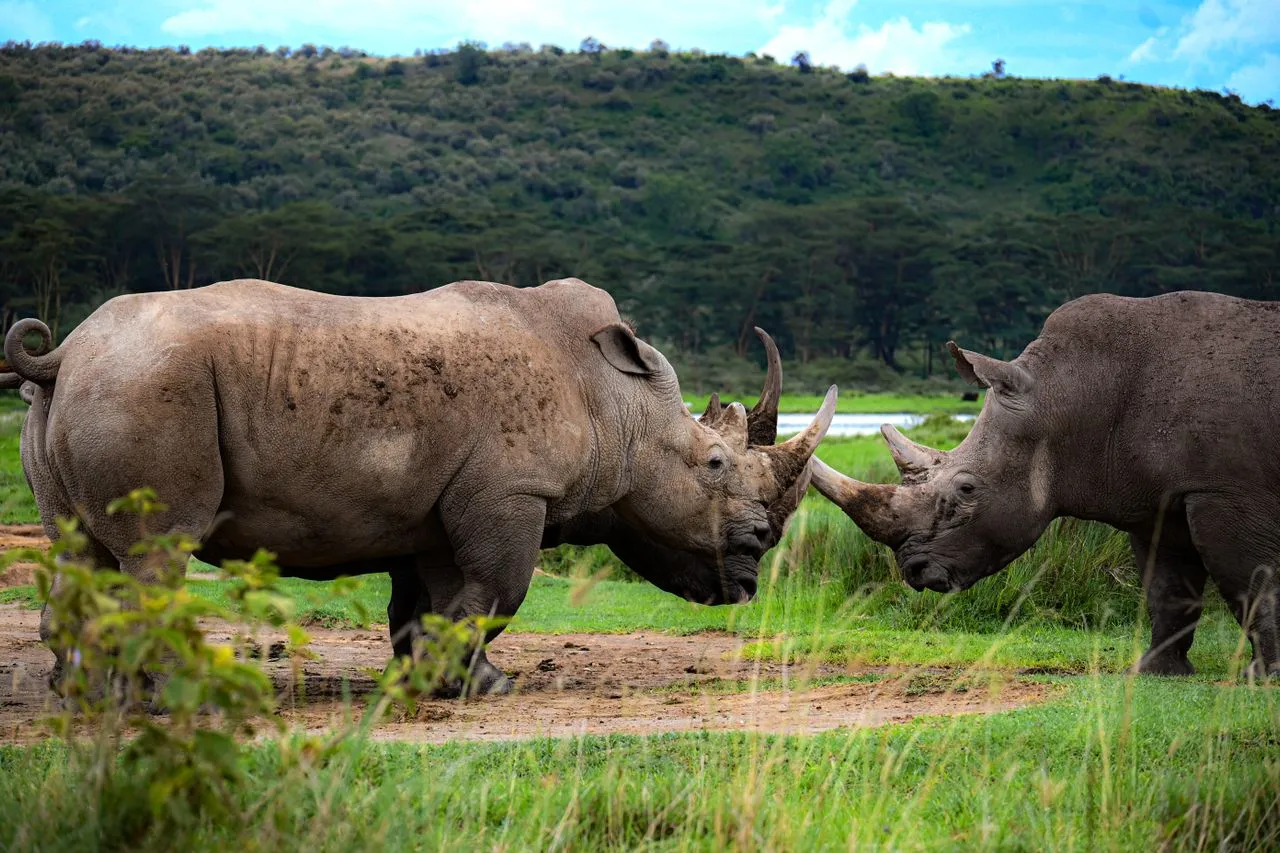
Here is how both titans rank on our CritterScore breakdown (rated out of 5):
| Feature | Hippopotamus | Rhinoceros |
| Raw Strength | 4.6 / 5 | 4.9 / 5 |
| Bite Power | 4.8 / 5 | 2.0 / 5 |
| Armor & Defense | 4.3 / 5 | 4.8 / 5 |
| Aggression | 4.9 / 5 | 3.1 / 5 |
| Overall Battle Winner | Land: Rhino (4.7) | Water: Hippo (4.8) |
Myth vs. Fact
Myth: Hippos and Rhinos constantly hunt each other for food in the wild.
Fact: Both animals are strictly herbivores! They eat grasses and aquatic vegetation. Any fight between them is purely about territory, water access, or self-defense.
Myth: A Rhino’s skin is so thick that a Hippo can’t bite through it.
Fact: While a Rhino’s skin is extremely tough armor, a Hippo’s 20-inch tusk teeth and 1,260 PSI bite pressure can definitely puncture thick hide if it catches a solid angle.
Quick Quiz
Test your memory! Drop your answers in your head or comments:
What is a Rhino’s horn actually made of?
A) Solid Bone
B) Keratin (same as human hair & nails)
C) Ivory
How wide can a Hippopotamus open its jaw?
A) 45 degrees
B) 90 degrees
C) Up to 180 degrees
(Hint: The answers are Keratin and 180 degrees!)
Critter Challenge
Here is today’s fun challenge: Imagine trying to open your mouth wide enough to stretch end-to-end like a straight line! That’s what a Hippo does effortlessly when displaying its 180-degree jaw yawn. Can you stretch your arms out to represent a Hippo’s jaw today without getting a cramp?

Frequently Asked Questions
Q: Who would win on open dry land?
A: On dry land, the Rhinoceros wins most of the time due to its heavier weight, lower center of gravity, and deadly charging horn momentum.
Q: Is a Hippo more dangerous to humans than a Rhino?
A: Yes! Hippos are responsible for far more human fatalities in Africa each year than Rhinos. They are far more aggressive and territorial near water paths.
Q: Are Rhinos or Hippos endangered?
A: Yes, both face major threats. Rhinos (especially Black and White rhinos) are severely targeted by illegal poaching for their horns, while Hippos face habitat loss and ivory tusk hunting.
Conclusion
In the ultimate showdown between two of Africa’s heavyweight titans, the winner comes down to location, location, location! On dry land, the Rhino’s superior weight and charging horn give it the winning edge. But inside shallow muddy waters, the Hippo’s vicious aggression and crushing 20-inch tusks make it an unbeatable aquatic force. Both are breathtaking natural wonders that deserve our active conservation support!
Related Articles on CritterPages
Can a Gorilla Really Lift 10 Times Its Body Weight? (The Truth About Primate Strength)
How Strong Is a Crocodile’s Bite? The Power Behind Its Deadly Jaws
Top 10 Strongest Animals in the Jungle
References & Sources
To keep things accurate and transparent, this battle breakdown was created using insights from these trusted wildlife sources: