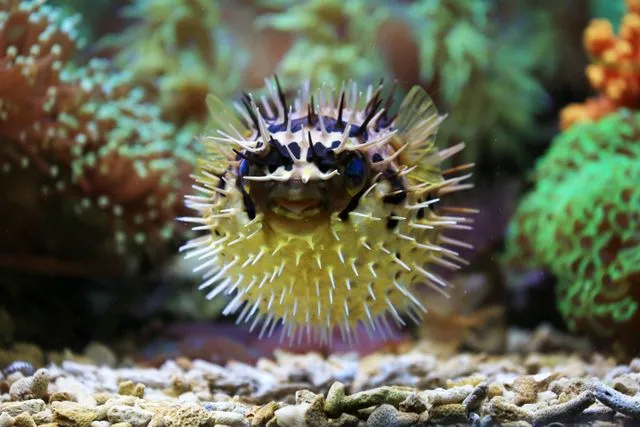
Pufferfish protect themselves using several clever defenses. When threatened, many species inflate their bodies with water, becoming much larger and harder for a predator to swallow. Some species also have sharp spines, while many pufferfish contain tetrodotoxin (TTX), a powerful toxin that can make them extremely dangerous to predators.
So a pufferfish doesn’t rely on just one trick.
It can become bigger, spikier, and potentially poisonous-all while being a surprisingly slow swimmer.
How Do Pufferfish Protect Themselves?
Pufferfish look almost comical when they’re swimming normally.
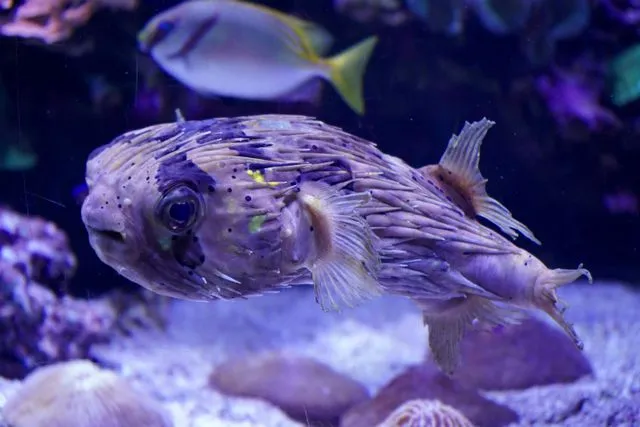
They have rounded bodies, small fins, large eyes, and a mouth with four strong tooth plates. But when a predator gets too close, their appearance can change dramatically.
Instead of trying to win a race, the pufferfish has another plan:
Become extremely difficult to eat.
When threatened, many pufferfish rapidly take in water and expand their elastic stomachs. Their bodies can become roughly two or three times their normal size. Suddenly, the small fish that looked like an easy meal has become a large, round object that is much harder to swallow.
This is one of the most unusual defensive strategies in the ocean.
How Does a Pufferfish Inflate?
The pufferfish doesn’t fill itself with air like a balloon.
In the wild, inflation generally happens by taking in water and expanding the stomach. The animal’s body has adaptations that allow it to increase in volume without simply bursting like an ordinary fish would.
National Geographic Kids describes pufferfish as filling their elastic stomachs with huge amounts of water, allowing them to become several times their normal size.
Once inflated, the fish looks completely different.
Its normally streamlined shape becomes a large, rounded ball.
That creates a problem for predators with narrow mouths.
Even if a predator manages to grab the fish, swallowing such a suddenly enlarged animal can become extremely difficult.
Some Pufferfish Have Spines Too
Inflation isn’t the only physical defense.
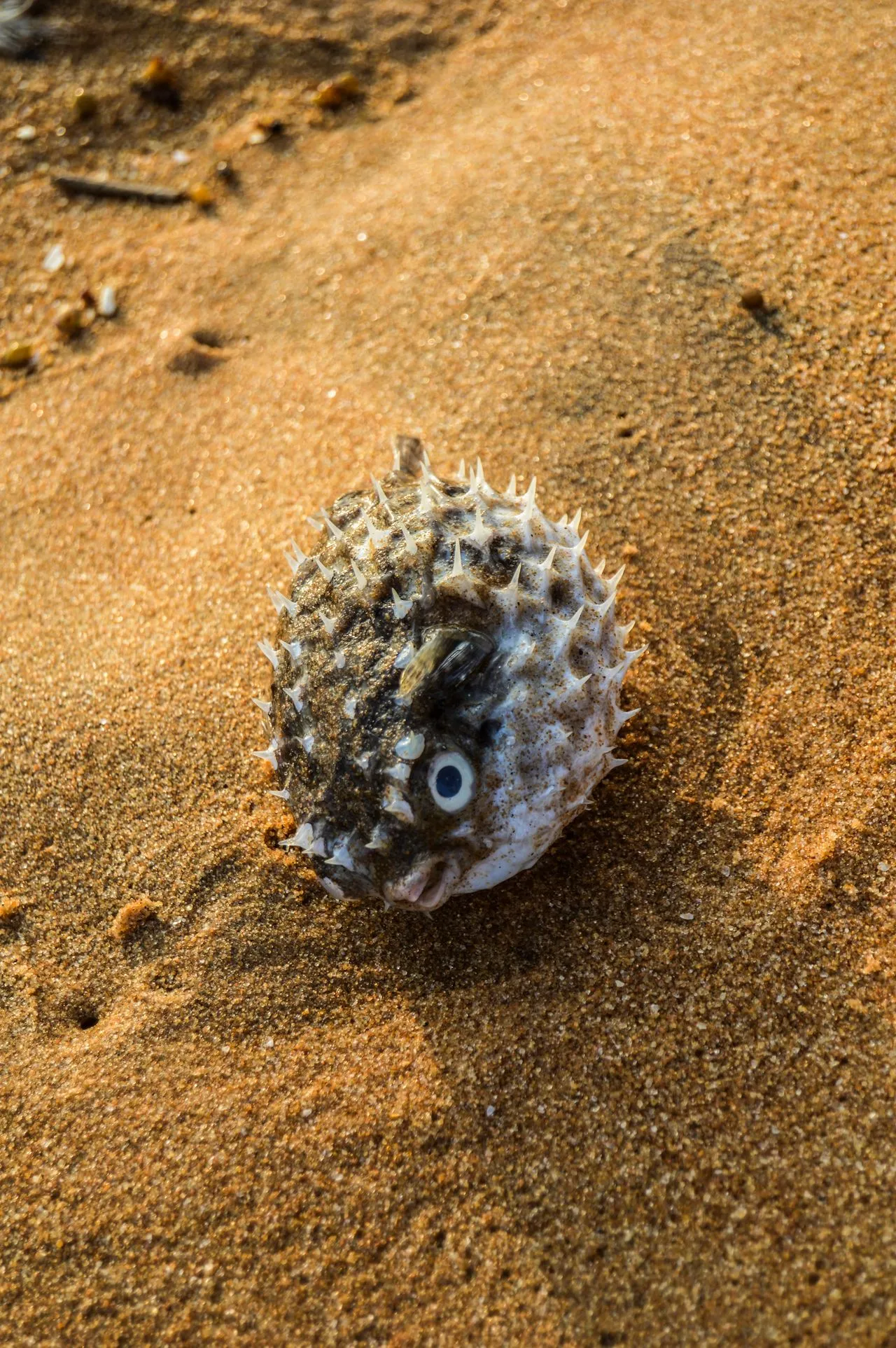
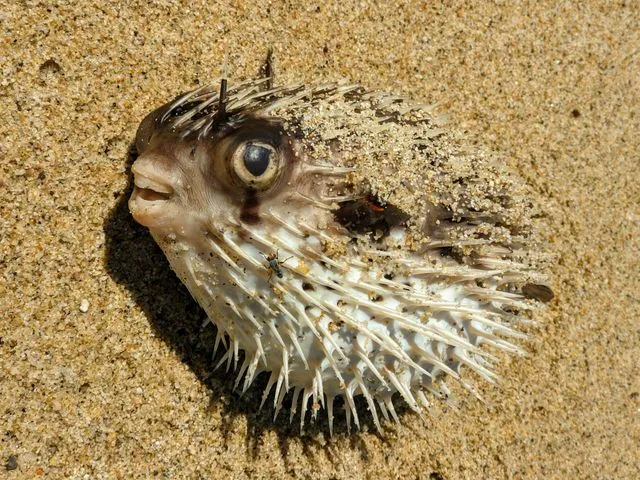
Some pufferfish species have spines on their skin. When the fish expands, those structures can make the inflated animal even more difficult and unpleasant for a predator to attack.
This is also why pufferfish are sometimes confused with their close relatives, porcupinefish.
They belong to different families, although both are part of the same broader order of fishes.
The two groups share some unusual defensive adaptations, but they are not the same animal.
Why Are Pufferfish Poisonous?
This is where pufferfish defense becomes even more serious.
Many pufferfish contain tetrodotoxin, or TTX, a powerful neurotoxin. It interferes with sodium channels that are essential for normal nerve and muscle function.
For a predator, eating a toxic pufferfish can therefore be extremely dangerous.
National Geographic Kids notes that most pufferfish contain a toxic substance that makes them unpleasant and potentially deadly to other fish.
The toxin is also dangerous to humans.
That’s why pufferfish prepared as fugu in Japan must be handled by properly trained professionals. Improperly prepared pufferfish can cause serious poisoning.
One important detail, though: toxicity isn’t identical in every pufferfish species or every individual. The amount and distribution of toxin can vary.
So it would be misleading to say that every pufferfish is equally poisonous.
A Defense System With More Than One Layer
Think about what a predator faces when it approaches a pufferfish.
Layer 1: Inflation
The fish suddenly becomes much larger.
Layer 2: Spines
In species that have them, the enlarged body can become even more difficult to swallow.
Layer 3: Toxicity
If the predator still manages to eat the fish, toxins may make the meal extremely dangerous.
This combination is what makes the pufferfish such an interesting example of animal defense.
It’s not simply one dramatic trick.
It’s a multi-layered survival strategy.
Why Doesn't the Pufferfish Just Swim Away?
Pufferfish are not particularly fast swimmers.
EBSCO describes many species as relatively slow and poor swimmers, although they can maneuver effectively in the water. Their small fins and unusual body shape give them good control, but not the kind of high-speed escape that you see in tuna or some other fast fish.
That helps explain why their defenses are so important.
If you can’t depend on speed, another solution is to make yourself a very difficult target.
Evolution has taken that idea quite far in pufferfish.
Where Do Pufferfish Live?
Pufferfish are found in a wide range of aquatic environments.
Most species live in tropical and subtropical marine waters, including shallow areas around coral reefs and aquatic vegetation. But some species live in brackish water or freshwater.
Their habitats can range from coral-rich coastal waters to freshwater environments, depending on the species.
Pufferfish Have Surprisingly Strong Teeth
Their defense isn’t the only unusual thing about their anatomy.
Pufferfish have four strong tooth plates that they use to crush hard foods such as mollusks and crustaceans. Some species also eat sea urchins and other tough-bodied animals.
Those teeth are powerful enough to break through hard shells.
So although a pufferfish may look soft and harmless, it has some serious equipment hidden inside that small mouth.
The Science Behind Their Inflation
Inflation isn’t simply the fish “getting fat” when frightened.
It is a rapid physical response involving water intake and expansion of the stomach and surrounding tissues.
Research on puffer relatives has also shown how specialized this ability can be. For example, a 2023 study of the three-tooth puffer documented inflation involving water being pumped into a specialized stomach region, producing a substantial increase in body volume.
Different species can have somewhat different anatomical mechanisms, so scientists don’t treat every puffer-like fish as having exactly the same inflation system.
That variation is another reminder that nature rarely uses a single blueprint.
CritterScore
Inflation Defense: ⭐⭐⭐⭐⭐(5/5)
Chemical Defense: ⭐⭐⭐⭐⭐(5/5)
Spine Protection: ⭐⭐⭐⭐(4/5)
Maneuverability: ⭐⭐⭐⭐(4/5)
Swimming Speed: ⭐⭐(2/5)
🏆 Standout Ability: Turning Into a Difficult-to-Swallow Ball
Myth vs Fact
Myth: Pufferfish inflate themselves with air like balloons.
Fact: In natural defensive inflation, many pufferfish take in water, expanding their stomachs and body.
Myth: Every pufferfish has large spikes covering its body.
Fact: Some species have noticeable spines, but pufferfish species vary considerably in appearance and defensive structures.
Myth: Every pufferfish contains exactly the same amount of poison.
Fact: Toxicity can vary among species, individuals, tissues, and circumstances.
Myth: Pufferfish are poisonous because they bite predators.
Fact: Their major chemical defense comes from toxins such as tetrodotoxin, rather than from a venomous bite.
Quick Quiz
1. What does a pufferfish usually take in to inflate?
A) Sand
B) Water
C) Air only
D) Food
2. What is the name of the famous pufferfish toxin?
A) Melatonin
B) Tetrodotoxin
C) Hemoglobin
D) Keratin
3. Why does inflation help protect a pufferfish?
A) It makes it invisible
B) It makes it swim faster
C) It makes it larger and harder to swallow
D) It lets it fly
Answers:
- B
- B
- C
Critter Challenge
Imagine you’re a predator looking for a small fish to eat.
You spot a pufferfish.
It looks manageable.
Then suddenly…
POOF!
The fish becomes a huge, round ball.
Now imagine trying to swallow it.
That’s the clever part of the pufferfish’s defense. It doesn’t necessarily need to overpower the predator. It simply changes the situation so quickly that the predator may decide the meal isn’t worth the risk.
Frequently Asked Questions
Can all pufferfish inflate?
Many pufferfish can inflate when threatened, but defensive abilities vary among species.
How big can a pufferfish become when inflated?
Many species can expand to around two or three times their normal size, although the exact amount varies by species.
Is pufferfish poison dangerous to humans?
Yes. Tetrodotoxin can be extremely dangerous to humans, and improperly prepared pufferfish can cause severe poisoning.
Do pufferfish have teeth?
Yes. They have strong tooth plates adapted for crushing hard-shelled prey such as mollusks and crustaceans.
Are pufferfish fast swimmers?
Generally, no. Many species are relatively slow swimmers but can maneuver well.
Final Thoughts
The pufferfish has one of those defenses that sounds almost too strange to be real.
When threatened, it can transform from a relatively small fish into a large, difficult-to-swallow ball. Some species add spines to the equation, and many carry powerful toxins that make predators think twice about taking another bite.
It may not be the fastest fish in the sea.
It doesn’t need to be.
The pufferfish survives by making itself a terrible choice for dinner.
If you enjoyed this article, you can also explore How Do Porcupines Defend Themselves? The Truth About Their Sharp Quills and How Intelligent Are Crows? here on CritterPages.
Keep exploring more animal abilities with CritterPages. 🐾
Sources
National Geographic Kids – Pufferfish
EBSCO Research Starters – Puffer Fish
Filo – How does a puffer fish protect itself?
NOAA – Research on pufferfish and tetrodotoxin
Bemis et al., Ichthyology & Herpetology – Research on inflation in the three-tooth puffer