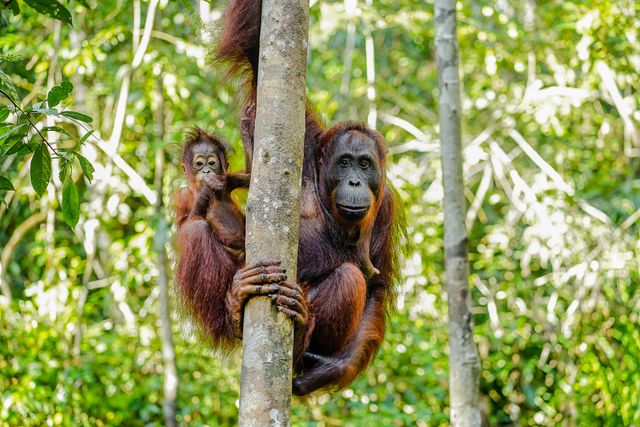
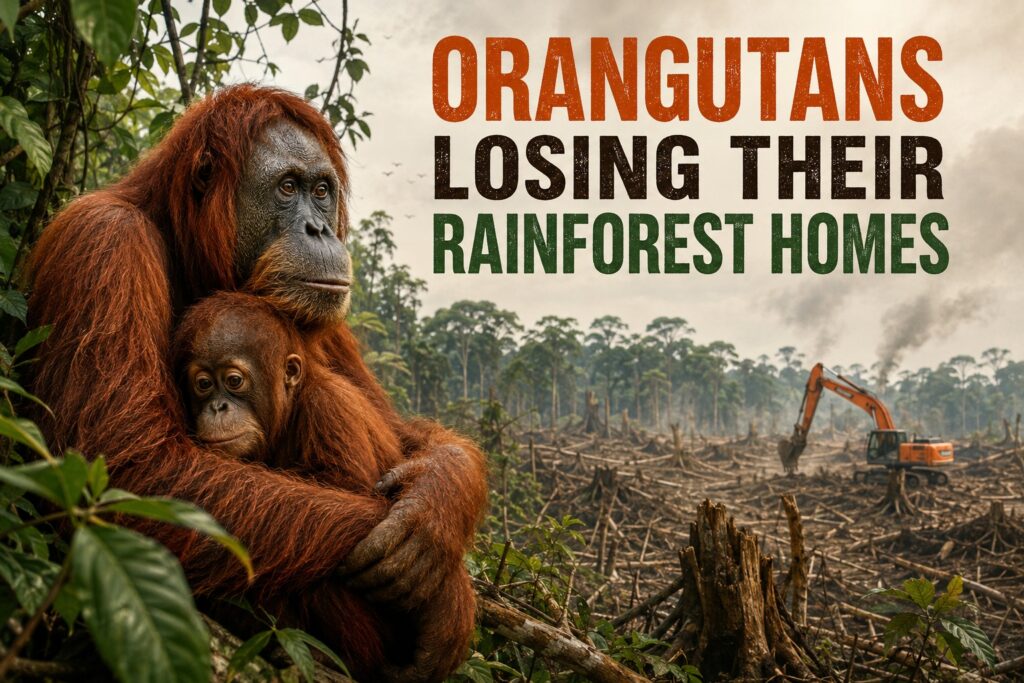
Orangutans are critically endangered mainly because their rainforest homes are being cut down for palm oil farms, timber, and roads. Losing their trees leaves these ancient apes without food, shelter, or safe places to raise their babies!
Imagine spending your whole life high in the canopy, swinging from branch to branch in a fluffy red coat, only to wake up one day and find your entire neighborhood gone. It sounds like a scary movie, but for orangutans, it is a daily fight for survival!
These gentle, red-furred apes are among our closest animal relatives and are true engineering geniuses of the treetops. However, as the tropical rainforests of Southeast Asia disappear, all three species of orangutans are officially listed as critically endangered.
In this guide, you’ll discover the major threats facing orangutans and how protecting them keeps entire rainforests alive. It is the perfect information to make your next school report stand out!
Losing Their Rainforest Homes
The biggest danger facing orangutans is habitat destruction. Massive areas of ancient rainforest on the islands of Borneo and Sumatra are chopped down or burned every single day to make room for agriculture, especially massive palm oil plantations.
Because orangutans spend about 90% of their lives high up in the trees, clearing the canopy destroys everything they need to survive:
-
Empty Pantries: They lose access to wild figs, bark, leaves, and insects.
-
No Safe Nests: They lose strong branches needed to build their daily sleeping beds.
-
Lost Travel Routes: They can no longer travel safely without stepping on the dangerous ground.
Trapped on Forest Islands
Even when parts of a rainforest are left standing, logging roads and farms chop the land into tiny, isolated patches. Scientists call this habitat fragmentation.
When forests are split up, orangutans get trapped on “green islands.” It becomes nearly impossible for them to find enough food throughout the year or meet other orangutans to start families.
Did You Know? 🌟
Orangutans are the ultimate rainforest gardeners! After eating wild fruit, they travel for miles and drop seeds across the forest floor in their poop. Many rainforest trees rely entirely on orangutans to plant new seeds!
Illegal Pet Trade and Conflict
When forests disappear, desperate and hungry orangutans sometimes wander into farm fields looking for food. This can cause dangerous conflicts with humans who want to protect their crops.
Tragically, young orangutans are also targeted by illegal poachers for the exotic pet trade. Because a mother orangutan will fight fiercely to protect her child, poachers often harm the mother just to capture the infant baby.
Wild Threats vs. Human Impacts
While orangutans face some natural challenges, human activities are by far their biggest hurdle.
| Threat Category | Specific Example | Impact on Orangutans |
| Human Activity | Rainforest clearing for palm oil | Destroys food sources, shelter, and nesting trees |
| Human Activity | Illegal poaching and pet trade | Removes infants from the wild and breaks up families |
| Natural Challenge | Slow reproduction cycle | Mothers give birth only once every 6 to 8 years |
Quick Fun Facts 🦧
-
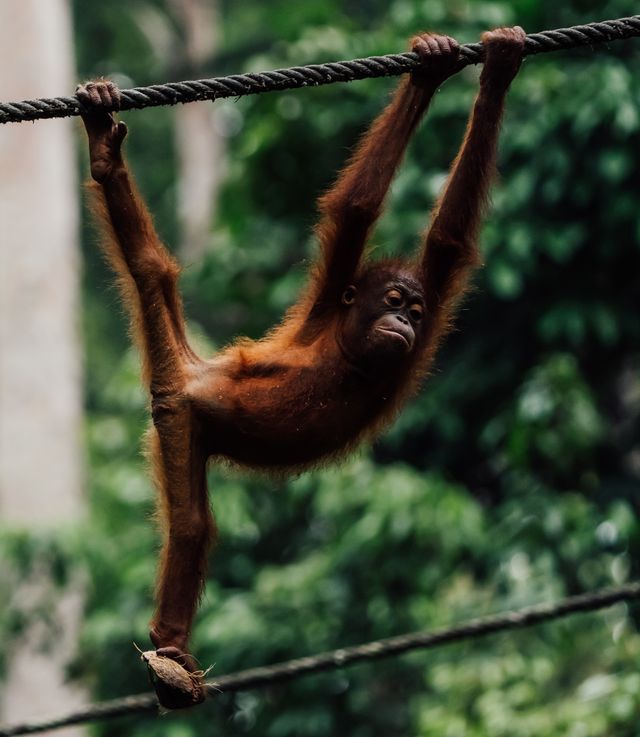
The word “orangutan” comes from the Malay language and means “person of the forest”!
-
Orangutans have long, powerful arms that can stretch up to 7 feet from fingertip to fingertip.
-
Orangutan kids stay with their mothers for up to 8 years—longer than almost any other mammal except humans!
-
They use large leaves like umbrellas to protect themselves from heavy rainforest downpours.
Myth vs. Fact: Orangutan Edition
| Myth | Real Fact |
| Orangutans live in Africa like chimpanzees and gorillas. | Orangutans live only on the Asian islands of Borneo and Sumatra! |
| Orangutans sleep in the same tree nest every night. | They construct a brand new, comfy leaf-and-branch nest high in the trees every single evening! |
| Orangutans are monkeys. | They are great apes! Unlike monkeys, orangutans have no tails and possess much larger brains. |
Frequently Asked Questions
Palm oil is a common oil used in foods and soaps. To build giant palm oil farms, workers cut down diverse rainforests, destroying the natural habitat orangutans rely on for survival.
There are three distinct species: the Bornean orangutan, the Sumatran orangutan, and the recently discovered Tapanuli orangutan. All three are critically endangered.
Orangutans are super smart! They use sticks as tools to dig out honey, make leaf gloves to handle prickly fruits, and solve complex puzzles in intelligence tests.
Kids can help by choosing products made with sustainable palm oil, recycling paper products to save trees, and spreading the word about rainforest conservation!
Conclusion
Orangutans are endangered because human activities like deforestation, habitat fragmentation, and illegal trade are destroying their tropical tree homes. By protecting the rainforests where these gentle red apes live, we also save thousands of other plants and animals that depend on the exact same ecosystem.
To explore more amazing animal survival guides, check out our articles on the top 10 smartest animals in the world and why sea turtles are endangered.