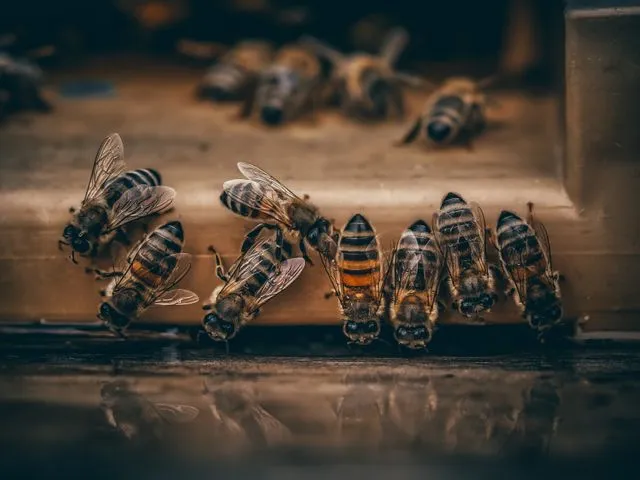
Honeybees dance to share a secret map with their hive mates! Their movements tell other bees the exact direction, distance, and quality of a patch of flowers so the colony can collect nectar fast.
Imagine coming home from the grocery store and doing a wiggly dance in your living room to tell your family where to find snacks. It sounds like a silly game, but for honeybees, it is a vital survival strategy!
Inside a buzzing hive of thousands of insects, finding food takes teamwork. When a scout bee finds a field of sweet flowers, she doesn’t use words or gestures. She performs a special routine called the waggle dance.
In this guide, you’ll discover how bees use the sun as a compass and turn dance moves into a GPS system. It is the perfect information to make your next school science report buzz!
What Is the Waggle Dance?
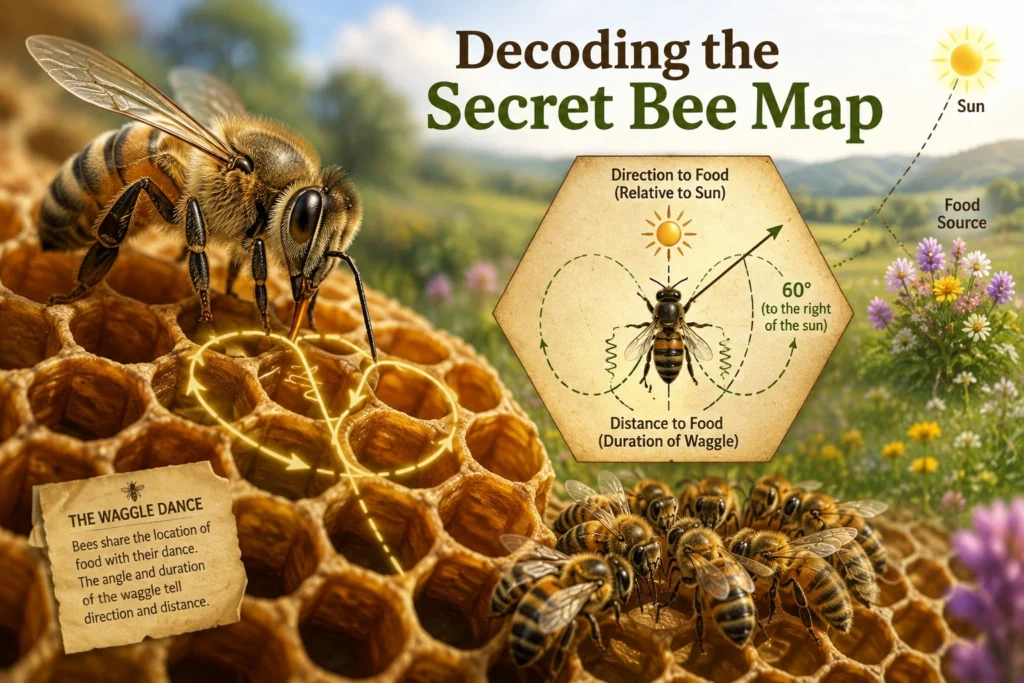
When a worker bee discovers a jackpot of fresh nectar or pollen, she flies straight back to the hive to share the good news. On the vertical honeycomb, she runs in a figure-eight pattern while rapidly shaking her abdomen side to side.
This combination of wiggling and buzzing sends vibrations through the comb. Other worker bees gather around in the dark hive, touching the dancer with their antennae to decode the message.
Decoding the Secret Bee Map
The waggle dance isn’t just random buzzing—it is a precise language that delivers three key pieces of information!
-
Direction: The angle of the dance tells bees where to fly relative to the position of the sun.
-
Distance: The length of the “waggle” run tells bees how far away the food is. A one-second waggle usually means the flowers are about 3,000 feet away!
-
Quality: The intensity and energy of the dance show how sweet and plentiful the nectar is.
Did You Know? 🌟
Honeybees can navigate using the sun even on cloudy days! They can detect polarized light passing through clouds, allowing them to calculate the sun’s position even when it is hidden from view.
The Sun as a Built-In Compass
How do bees give directions inside a dark beehive? They convert the angle of the sun into an upward or downward direction on the honeycomb!
If the bee dances straight up the comb, it means “fly directly toward the sun.” If she dances at a 45-degree angle to the right of vertical, it means “fly 45 degrees to the right of the sun.”
Types of Bee Dances
Honeybees use different dances depending on how close or far away the food source is located.
| Dance Type | Distance to Food | Movement Pattern |
| Round Dance | Very close (under 100 meters) | Moving in small circles, changing direction back and forth |
| Waggle Dance | Far away (over 100 meters) | Figure-eight pattern with a straight, vibrating “waggle” run |
Myth vs. Fact: Bee Dance Edition
| Myth | Real Fact |
| Bees dance just to celebrate finding food. | The dance is a precise communication code sharing direction and distance! |
| All species of bees do the waggle dance. | The waggle dance is unique to honeybees. Bumblebees and solitary bees do not use it. |
| Bees see the world the same way humans do. | Bees see ultraviolet light, which reveals hidden “bullseye” patterns on flowers! |
Quick Fun Facts 🐝
Karl von Frisch won a Nobel Prize in 1973 for cracking the code of the honeybee waggle dance!
Honeybees can fly at speeds up to 15 miles per hour to reach flower patches.
A single bee would have to visit about 2 million flowers to make one pound of honey.
Bees also use smell—the dancer carries the flower’s scent on her body so recruit bees know what to sniff for!
Frequently Asked Questions
A single colony can contain up to 60,000 bees! Communicating food locations helps the colony gather huge amounts of nectar efficiently before other insects find the flowers.
Bees measure distance by tracking how fast visual landscape features move past their eyes as they fly. Scientists call this "optic flow."
Yes! Inside the dark hive, bees rely on touch and sound. Nearby bees feel the dancer's movements with their antennae and sense vibration frequencies through the honeycomb.
Bees have an internal biological clock that automatically calculates the movement of the sun across the sky, adjusting their dance angles as time passes!
Conclusion
Honeybees dance because it is an amazingly accurate way to guide their hive mates to rich patches of flowers. By combining direction, distance, and the position of the sun into a rhythmic wiggle, these tiny insects work together as a super-smart team.
To learn more about awesome animal superpowers, check out our fun guides on why woodpeckers peck trees and why cats purr.