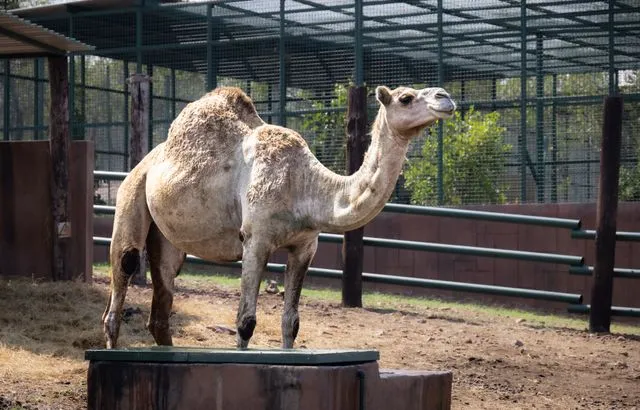
Camels have humps because they are specialized fat-storage areas. Contrary to a popular myth, camels do not store water in their humps.
The stored fat provides energy when food is scarce. Keeping much of the body’s fat in one place instead of spreading it across the body may also help the camel manage heat in a hot environment.
And there is an interesting detail: not all camels have the same number of humps.
- 🐪 Dromedary camel: one hump
- 🐫 Bactrian camel: two humps
So, if you’ve ever wondered why a camel has that strange-looking bump on its back, the answer is actually more useful than it looks.
What Is Inside a Camel's Hump?
The simple answer is fat.
A camel’s hump is a specialized fat reserve. Instead of distributing large amounts of fat evenly across its body, the camel stores much of it in the hump.
That gives the animal an important energy supply.
When food is plentiful, a camel can build up its fat reserves. When food becomes difficult to find, the body can use that stored fat for energy.
This is especially useful in places where vegetation can be sparse and unpredictable.
Think of the hump as a built-in energy reserve.
It’s not a water tank.
Animal: Camel
Main adaptation: Fat-storing hump
Dromedary: One hump
Bactrian camel: Two humps
Hump stores: Fat, not water
Main habitat: Deserts, dry grasslands, and steppes
Do Camels Store Water in Their Humps?
No.
This is one of the most common camel myths.
A camel’s hump contains fat, not a reservoir of water.
The misunderstanding probably comes from another amazing camel ability: these animals are exceptionally good at conserving water.
So the hump and the camel’s water-saving abilities are related to desert survival, but they are not the same thing.
The hump provides stored energy, while the camel’s body has several other adaptations that help reduce water loss.
That’s an important distinction.
How Does Fat Help a Camel in the Desert?
Fat contains a lot of stored energy.
When a camel needs energy and doesn’t have enough food available, its body can break down fat from the hump and use it as fuel.
But there’s another interesting advantage to keeping much of the fat in one concentrated area.
Fat is a good insulator.
If a large amount of fat were spread evenly underneath the camel’s skin, it could interfere with the body’s ability to lose heat.
By concentrating much of its fat in the hump, the camel keeps other parts of its body relatively less insulated.
That doesn’t mean the hump is an air conditioner. But its unusual fat-storage arrangement is one part of the camel’s overall heat-management strategy.
Why Does a Camel's Hump Shrink?
Here’s something you can actually see.
A healthy camel with plenty of stored fat can have a firm, upright hump.
If the camel uses a large amount of its stored energy, the hump can become smaller and may even droop or flop to one side. After the animal feeds and rebuilds its fat reserves, the hump can become upright again.
So the shape of the hump can tell you something about the camel’s current energy reserves.
It’s almost like a visible fuel gauge but not a precise one.
One Hump or Two Humps?
Not all camels look the same.
🐪 Dromedary Camel
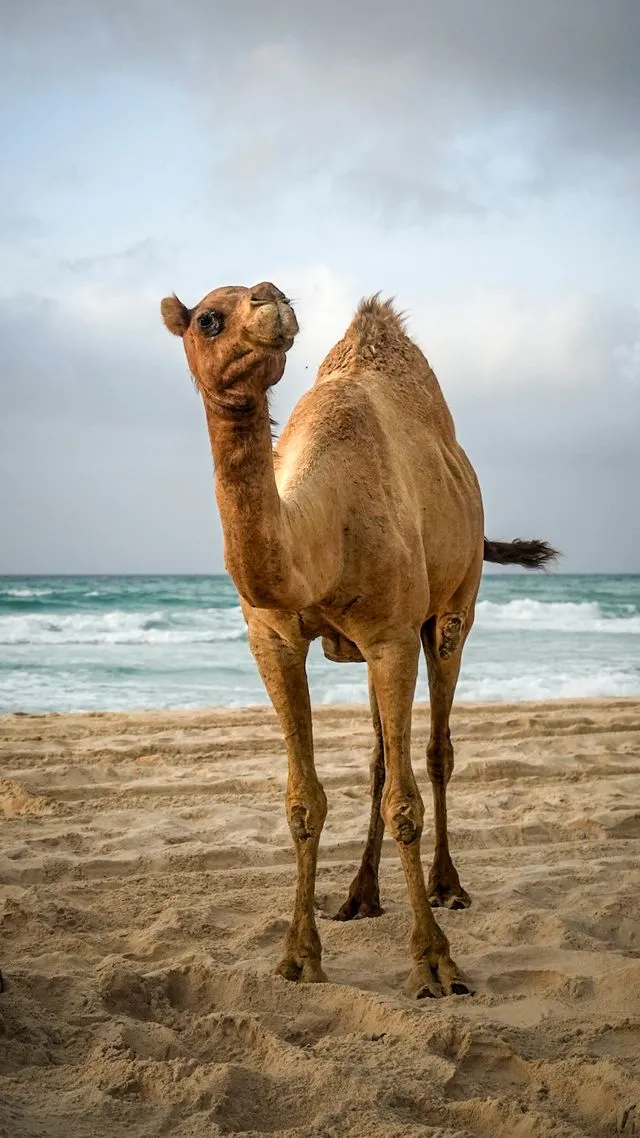
The dromedary, often called the Arabian camel, has one hump.
It is widely associated with the deserts of North Africa, the Middle East, and parts of Asia, and domesticated dromedaries are also found in other regions.
🐫 Bactrian Camel
The Bactrian camel has two humps.
Wild Bactrian camels are adapted to harsh environments of Central Asia, where conditions can be extremely dry and temperatures can vary dramatically.
The two species look different, but their humps serve the same basic purpose:
fat storage.
Where Do Camels Live?
Camels are strongly associated with deserts, but their story is broader than that.
Dromedaries are especially common in arid regions of Africa and Asia, while Bactrian camels are associated with Central and East Asia.
Interestingly, camel ancestors were not originally creatures of today’s hot deserts.
Discover Wildlife notes that ancient camel relatives lived in the Arctic millions of years ago, and fossils show that some early camels were much larger than modern camels. Their adaptations later proved useful when camel lineages expanded into warmer, drier environments.
[Insert Camel Distribution Map Here]
From Arctic Forests to Desert Survivors
This is one of the strangest parts of camel evolution.
It is easy to imagine that camels must have always evolved in hot deserts.
But fossil evidence tells a different story.
Fragments of ancient camel bones found in Canada’s Arctic indicate that camel relatives lived in northern environments millions of years ago. At that time, the region was much warmer and supported forests.
As climates changed, camel relatives moved into different environments.
Some of the traits that had evolved for survival in colder environments later became useful in deserts.
For example, broad feet that helped spread weight on soft ground or snow are also useful on loose desert sand. Their thick coats, which can protect against cold, can also help shield the body from intense sunlight.
Evolution doesn’t always create a feature for one environment and then throw it away when the environment changes.
Sometimes an old adaptation becomes useful in a completely different place.
The Real Secret: Camels Are Water Conservers
The hump gets most of the attention, but it isn’t the only reason camels can survive in dry environments.
Camels are excellent at reducing water loss.
WWF notes that camels can survive for extended periods without water and are highly effective at conserving what they have. They also can consume a very large amount of water when it becomes available.
Other adaptations help too.
Their bodies can tolerate dehydration better than humans, and they have physiological mechanisms that reduce unnecessary water loss.
Their noses are also specially adapted to desert conditions, helping limit moisture loss during breathing while filtering dust from incoming air.
So the camel’s survival strategy isn’t one magical feature.
It’s a whole collection of adaptations working together.
Myth vs Fact
| Myth | Fact |
|---|---|
| Camels store water in their humps. | Camels store fat in their humps. |
| All camels have two humps. | Dromedaries have one; Bactrian camels have two. |
| The hump alone lets camels survive deserts. | Their survival depends on several adaptations working together. |
Quick Quiz
1. What does a camel store in its hump?
A) Water
B) Fat
C) Air
D) Sand
2. How many humps does a dromedary camel have?
A) One
B) Two
C) Three
D) None
3. What happens when a camel uses much of the fat stored in its hump?
A) It becomes harder
B) It disappears permanently
C) It can shrink and droop
D) It fills with water
Answers:
- B
- A
- C
CritterScore
🐪 Energy Storage: ⭐⭐⭐⭐⭐(5/5)
💧 Water Conservation: ⭐⭐⭐⭐⭐(5/5)
🔥 Heat Management: ⭐⭐⭐⭐⭐(5/5)
🌵 Desert Adaptation: ⭐⭐⭐⭐⭐(5/5)
🏃 Speed: ⭐⭐⭐(3/5)
🏆 Standout Ability: Storing Fat While Conserving Water
Frequently Asked Questions
Do camels really store water anywhere in their body?
They don’t have a special water tank in the hump. Their ability to survive dry conditions comes from drinking when water is available and, more importantly, from being extremely effective at conserving water.
Why does a camel’s hump become smaller?
When the camel uses stored fat for energy, the amount of fat in the hump decreases. The hump can become smaller and droop to one side.
Which camel has two humps?
The Bactrian camel has two humps. The dromedary camel has one.
Can camels survive without water?
Camels can survive surprisingly long periods without drinking, although the exact duration depends on conditions such as temperature, activity, food, and access to moisture. WWF describes them as highly effective water conservers.
Why are camels good at living in deserts?
Their survival comes from multiple adaptations, including fat storage, water conservation, heat management, specialized feet, and other physiological features that help them cope with arid environments.
Final Thoughts
The camel’s hump is one of those animal features that almost everyone recognizes—but many people know the wrong reason for it.
It doesn’t hold a tank of water.
It holds fat.
That stored energy, combined with the camel’s remarkable ability to conserve water and handle heat, helps turn an animal that looks unusual into one of nature’s great desert survivors.
And perhaps the most surprising part of the story is that camels didn’t simply begin as desert animals. Their ancient relatives lived in environments very different from today’s deserts, showing how evolution can reshape old adaptations for new challenges.
If you enjoyed this camel survival story, you can also explore How Do Pufferfish Protect Themselves? The Amazing Defense Strategy Explained and Penguins: The Flightless Birds That Rule the Ice on CritterPages.
Keep exploring more animal abilities with CritterPages. 🐾
Sources
WWF – What do camels store in their humps? And other camel superpowers
Discover Wildlife – How did the camel get its hump?
Awesome Animals – Why Do Camels Have Humps?
Britannica – Do Camels Store Water in Their Humps?